What Is the Best Vehicle for Carp Fishing? 4×4, SUV, Estate or Van
Choosing a fishing vehicle is not simply a question of buying the biggest 4×4 you can afford. Carp anglers have an unusual set of requirements: a large amount of tackle, long rods, wet and muddy equipment, long motorway journeys and, depending on the venue, access roads that may be little more than farm tracks.
For some anglers, a van is almost perfect. For others, a practical estate is all they need. If your fishing regularly takes you across wet fields, deep ruts or rough tracks, however, four-wheel drive and extra ground clearance can become much more important.
The best choice depends on where you fish, how much equipment you carry and whether the vehicle also needs to work as an everyday family car.
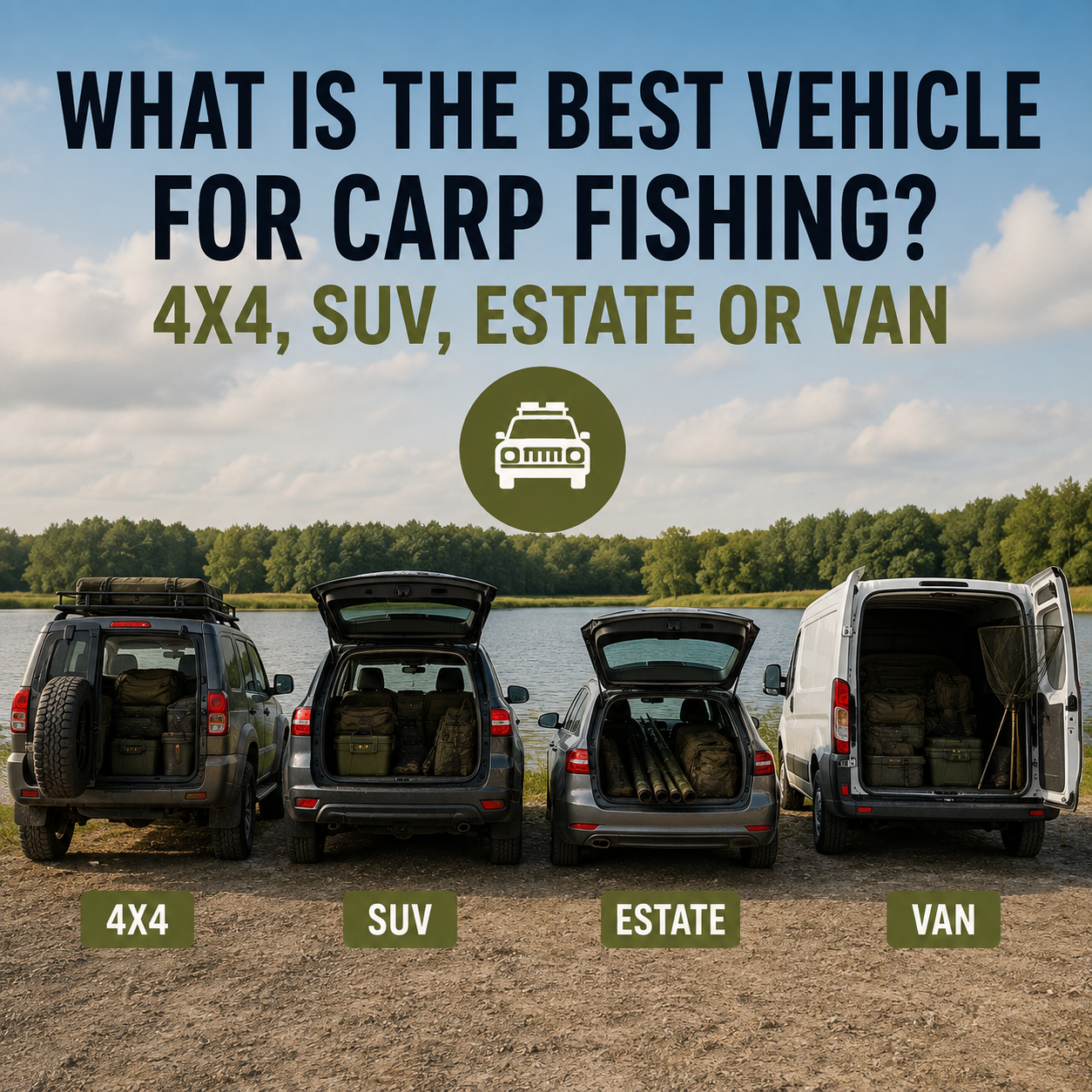
What Actually Matters in a Carp Fishing Vehicle
Before comparing vehicle types, think about the job the vehicle needs to do.
Luggage capacity is obvious, but usable load space matters more than a headline boot-volume figure. Long, flat space is particularly useful for rods, nets, bivvies and bedchairs.
Ground clearance matters when tracks are deeply rutted, while four-wheel drive can be valuable on wet grass, mud and loose surfaces.
Tyres are equally important. A capable 4×4 on unsuitable road tyres can still struggle where a less sophisticated vehicle on appropriate tyres keeps moving.
Other useful characteristics include:
- low loading height
- wide tailgate
- roof-rack compatibility
- easy-to-clean interior materials
- enough payload for tackle, bait, water and passengers
- adequate ground clearance
- practical storage for wet and muddy equipment
Estate Cars: Excellent for Road Miles
An estate can be one of the best all-round choices for anglers who mainly fish established venues with reasonable access.
They are usually comfortable and efficient on long journeys, easy to use every day and offer a long load floor with the rear seats folded.
For European trips, where hundreds of motorway kilometres may separate home from the lake, this can be a major advantage.
The weakness becomes obvious when access deteriorates.
Low ground clearance and two-wheel drive can become limiting on deeply rutted tracks or saturated grass. Four-wheel-drive estates such as the Subaru Outback or similar vehicles can bridge some of that gap without becoming full-size off-roaders.
For an angler who spends most of the journey on tarmac and only occasionally uses rough access roads, an estate can be an excellent compromise.
Vans: Maximum Practicality
For pure tackle-carrying ability, a van is difficult to beat.
A van can swallow a barrow, bivvy, bedchair, bait and other equipment without the careful packing required in many SUVs.
Depending on the layout, rods and other long items can remain assembled or stored securely inside.
This makes vans particularly attractive to frequent anglers and people who want a dedicated fishing vehicle.
The trade-off is that many two-wheel-drive vans are not especially happy on wet fields or badly rutted access tracks.
Four-wheel-drive vans exist, but they tend to cost more and the choice is narrower.
For anglers fishing mostly commercial or well-maintained venues, a van may still be the most practical option of all.
SUVs: The Everyday Compromise
An SUV can be a very good compromise when one vehicle needs to handle family life, commuting and fishing.
Modern SUVs generally provide easier access, useful luggage space and more ground clearance than conventional cars.
But it is important not to assume that every SUV is a true off-roader.
Many are front-wheel drive, and even all-wheel-drive models vary greatly in rough-terrain ability.
For ordinary gravel tracks and wet grass, a sensible AWD SUV with appropriate tyres may be entirely adequate.
For more demanding access, look more carefully at:
- ground clearance
- underbody vulnerability
- approach and departure angles
- wheel and tyre choice
- four-wheel-drive system
- location of low-mounted components
If a vehicle is regularly used on rough access roads, proper underbody protection can also be worth considering, particularly where the engine, transmission or fuel tank sits relatively close to the ground.
Proper 4x4s: Best for Difficult Access
If your fishing takes you to remote rivers, wild lakes, forestry tracks or venues where access changes dramatically with the weather, a genuine 4×4 becomes much easier to justify.
Vehicles such as the Toyota Land Cruiser, Land Rover Defender, Mitsubishi Shogun/Pajero, Nissan Patrol and similar designs were built with difficult terrain in mind.
Pick-ups such as the Ford Ranger can also combine substantial carrying capacity with strong off-road ability.
The advantages are usually:
- better traction
- increased ground clearance
- stronger off-road capability
- more confidence on rough terrain
- useful towing ability
The disadvantages are usually:
- higher purchase price
- greater fuel consumption
- larger size
- higher running costs
For a carp angler who spends most weekends on well-maintained fisheries, this capability may be unnecessary.
For someone regularly reaching remote waters, however, it can be the difference between fishing and turning around.
Do You Really Need Four-Wheel Drive?
Not necessarily.
A large proportion of carp fishing can be done perfectly well with a normal car or van.
If the venue has a gravel car park and maintained tracks, buying a heavy 4×4 purely for fishing makes little sense.
Four-wheel drive becomes more valuable when the main problem is traction:
- wet grass
- mud
- steep tracks
- loose surfaces
- soft ground
Ground clearance becomes important when the problem is physical obstacles:
- deep ruts
- rocks
- raised track centres
- exposed roots
- uneven surfaces
These are separate issues.
A low AWD estate may have excellent traction but still contact the ground in deep ruts.
A high two-wheel-drive van may have plenty of clearance but struggle to find grip on wet grass.
Underbody Protection Is Worth Considering
Rough fishing access rarely looks like extreme off-roading.
That can make it deceptively risky.
A slow drive along a deeply rutted track can put the engine sump, transmission, fuel tank or other components close to stones, roots and hard ground.
Factory plastic covers should not automatically be treated as impact protection.
If the vehicle regularly travels beyond maintained roads, proper underbody protection can be a sensible preventative upgrade.
Steel and aluminium are the two most common materials used for skid plates. The appropriate choice depends on the vehicle, how often it leaves the road and the severity of the terrain.
For a detailed comparison, read:
Steel vs Aluminium Skid Plates: Which Material Is Right for Your Vehicle?
Pick-Ups: Useful, but Think About the Load Bed
Pick-ups are attractive fishing vehicles because they combine genuine off-road capability with a large cargo area.
A covered load bed can keep muddy equipment separate from the cabin.
This is particularly useful after a wet session when nets, unhooking mats, boots and other equipment are covered in mud.
However, an open bed needs a secure canopy or hard cover if expensive tackle is left inside.
The rear load area can also be high, making heavy equipment more awkward to load than in a van.
Before choosing a pick-up, think carefully about security and how you intend to organise the load bed.
Do Not Forget Payload
Carp fishing equipment can become surprisingly heavy.
A complete setup may include:
- rods and reels
- bivvy
- bedchair
- barrow
- bait
- batteries
- food
- cooking equipment
- drinking water
- clothing
- recovery equipment
Once passengers are added, the total load can become substantial.
Payload is therefore worth checking before buying a vehicle, especially if you regularly travel for longer sessions.
A vehicle that looks large does not necessarily have unlimited carrying capacity.
Long-Distance Comfort Matters Too
It is easy to focus entirely on off-road capability.
But many carp anglers spend far more time on motorways than on muddy tracks.
If you regularly travel across Europe to fish, comfort, fuel economy, noise levels and driving range become very important.
A highly capable 4×4 that is uncomfortable or expensive on a 1,000-kilometre journey may not be the best overall choice.
This is one reason estates, vans and modern SUVs remain popular with anglers.
The ideal fishing vehicle should work well during the entire journey, not just the final kilometre.
Five Practical Questions Before You Buy
Rather than choosing a vehicle because it looks adventurous, ask five simple questions.
1. Will my normal tackle fit?
Think about your real equipment rather than quoted boot capacity.
Can you fit your bedchair, bivvy, barrow, rods, bait and luggage without awkward stacking?
2. Can it reach the venues I actually fish?
If you only use surfaced car parks, you probably do not need a serious off-roader.
If you regularly use forest tracks, wet fields or deeply rutted approaches, clearance and traction become much more important.
3. Is it comfortable enough for my normal journeys?
A fishing vehicle may spend hundreds of kilometres on the motorway before reaching a rough track.
4. Can it handle wet and muddy equipment?
Easy-to-clean surfaces, rubber mats and separate cargo areas can make life much easier.
5. Can I afford to maintain it properly?
Large 4x4s can bring higher costs for tyres, servicing, fuel and repairs.
A vehicle that answers these questions well is likely to be a better fishing vehicle than one chosen purely for maximum off-road capability.
Final Thoughts
There is no universal best carp fishing vehicle.
For mostly paved access and long-distance travel, an estate can be hard to beat.
For maximum load space, a van is exceptionally practical.
An SUV offers a useful everyday compromise, while a genuine 4×4 or pick-up makes sense when difficult access is a regular part of your fishing.
The important point is to match the vehicle to the waters you actually fish.
A huge off-roader is unnecessary if every session starts in a surfaced car park.
Equally, a low road car can become frustrating very quickly when your favourite water sits at the end of a muddy, rutted track.
Choose around your real fishing rather than the image of it, and you will end up with a vehicle that spends more time getting you to carp and less time becoming another problem to solve.